-
-
Trusted Partners For:
ISO-ACCREDITED INFRARED THERMOGRAPHY TRAINING IN AFRICA
-
-
Trusted Partners For:
ISO-ACCREDITED MACHINERY LUBRICATION TRAINING IN AFRICA
Aset Matrix Reliability Centre
2026 Program Catalog
Explore our 2026 program catalog for the latest updates, available courses, and key details.
COURSES & CERTIFICATIONS
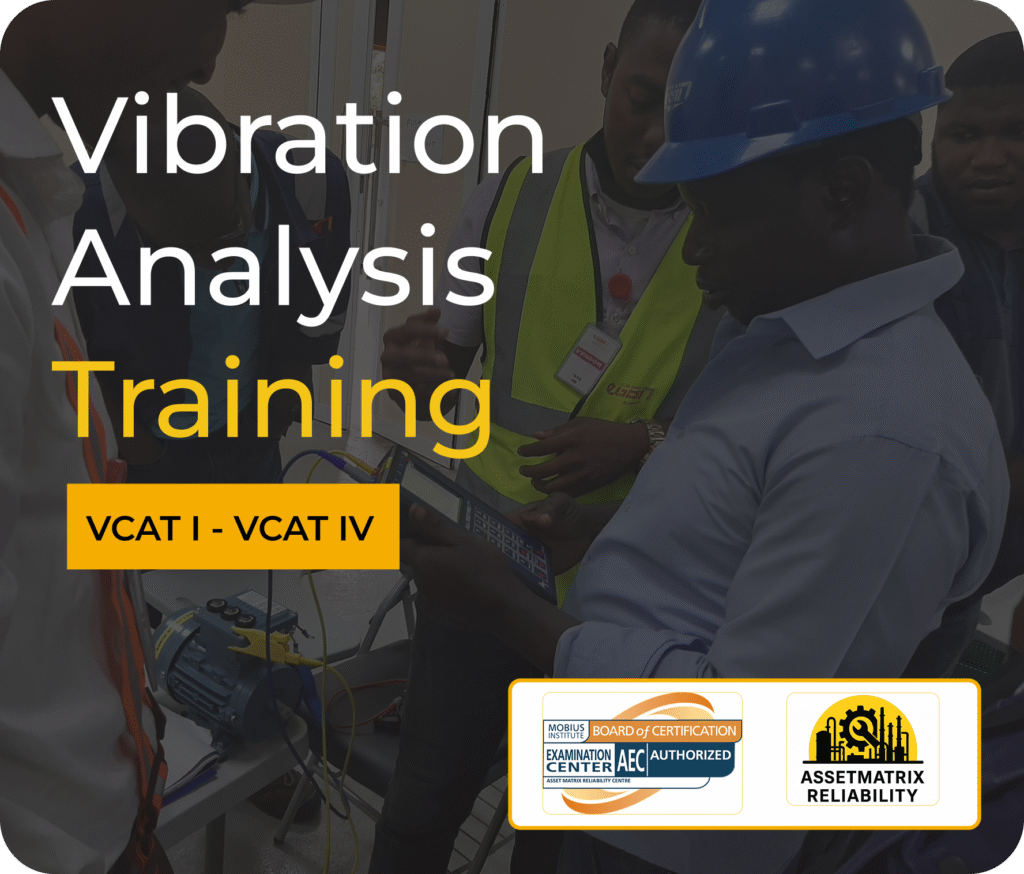
Vibration Analysis Courses, VCAT I - VCAT III
Vibration Analysis (VCAT I)
Certification: Mobius Institute Category I (ISO 18436-2).
Duration: 5 Days
Who this is for: Entry-level maintenance technicians, operators, and reliability staff new to vibration analysis.
What you’ll learn:
- Fundamentals of vibration analysis and signal processing.
- Introduction to condition monitoring and its importance.
- Basic fault diagnosis for imbalance, misalignment, and looseness.
Vibration Analysis (VCAT II)
Certification: Mobius Institute Category II (ISO 18436-2)
Duration: 5 Days
Who this is for: Reliability engineers, maintenance supervisors, and technicians with some experience in vibration analysis
What you’ll learn:
- Intermediate vibration analysis concepts and spectrum interpretation.
- Fault diagnosis for bearings, gears, and electric motors.
- Establishing alarm limits and condition monitoring programs.
- Hands-on problem-solving strategies with real case examples.
Vibration Analysis (VCAT III)
Certification: Mobius Institute Category III (ISO 18436-2)
Duration: 5 Days
Who this is for: Senior reliability engineers, analysts, and asset managers responsible for developing or managing condition monitoring programs.
What you’ll learn:
- Advanced vibration analysis and signal processing techniques.
- Root cause analysis of complex machinery faults.
- Program design, implementation, and management of condition monitoring systems.
- Case studies on large industrial applications and strategic decision-making.
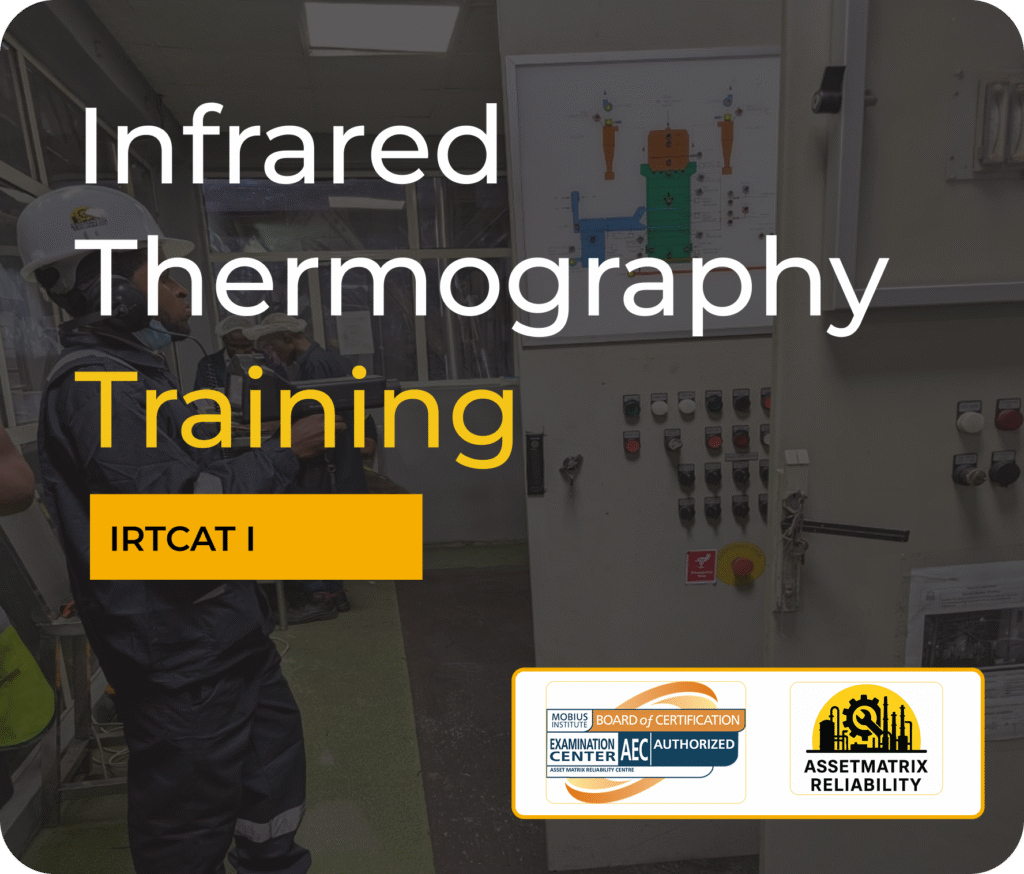
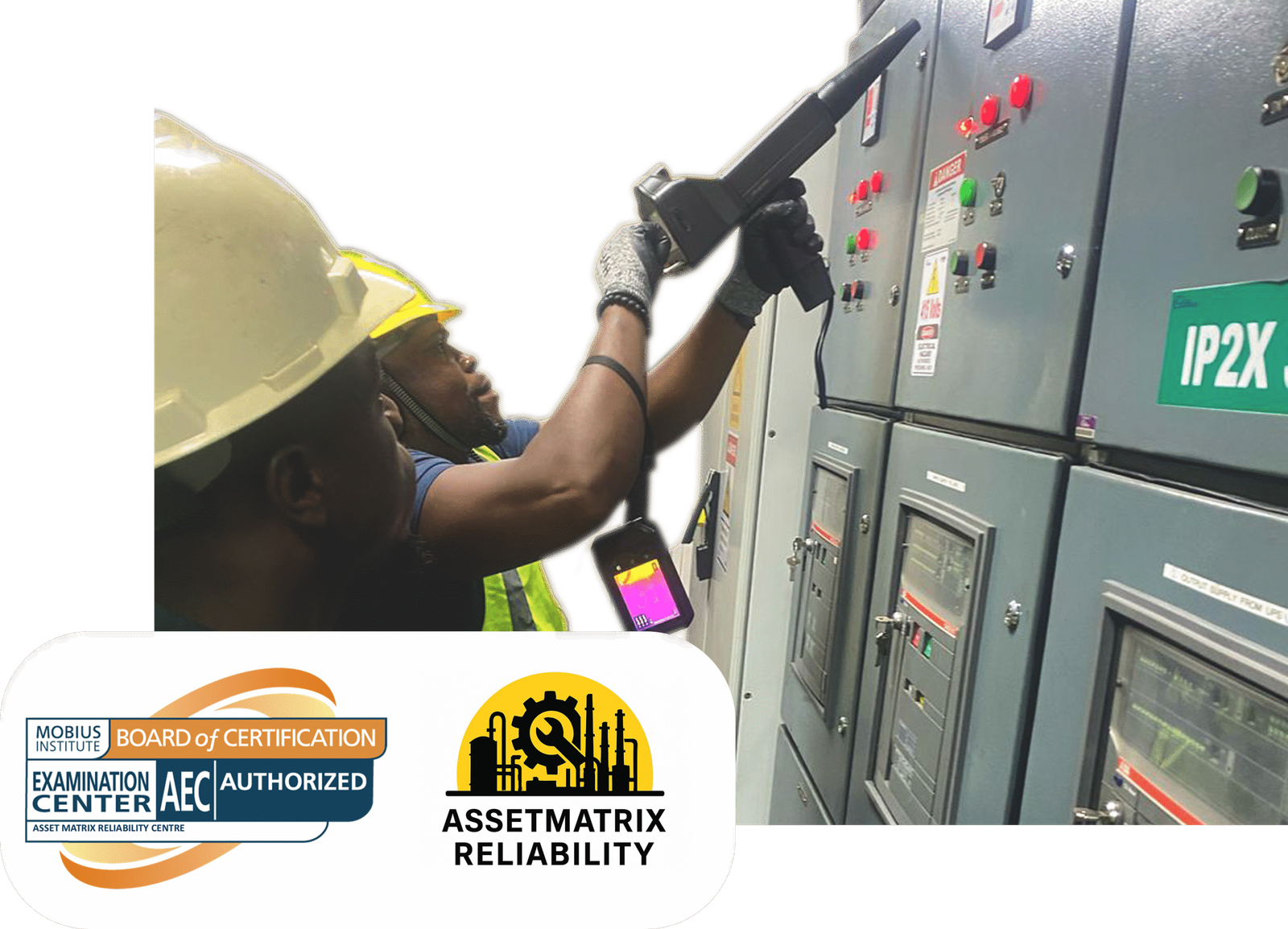
Infrared Thermography Courses IRTCAT I
Infrared Thermography (IRTCAT I)
Certification: Mobius Institute IRTCAT I Certification, internationally recognized and compliant with ISO 18436-7 standards.
Duration: 3-5 Days
Who this is for: Engineers, maintenance staff, and reliability professionals responsible for predictive maintenance and asset monitoring
What you’ll learn:
- Core principles of infrared thermography and thermal imaging.
- Application of IR technology in identifying electrical, mechanical, and building-related faults.
- Hands-on training with infrared cameras and software for data interpretation.
- Industry best practices for safety, accuracy, and reporting.
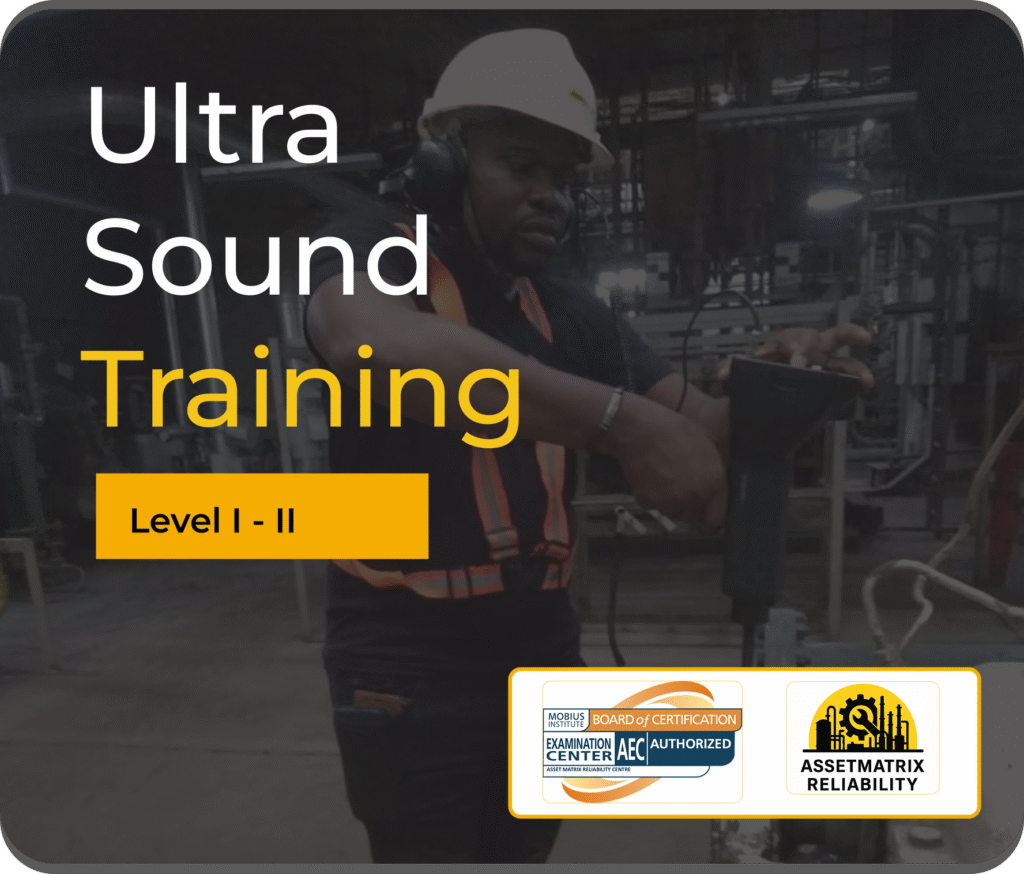
Ultrasound Courses, LV I - LV II
Ultrasound Inspection Training & Certification - Level I
Certification: ISO 18436-8, Mobius Institute Level I.
Duration: 5 Days
Who this is for: Entry-level maintenance technicians, inspectors, and engineers who want to develop foundational skills in ultrasound inspection.
What you’ll learn:
- Fundamentals of ultrasound technology and its applications.
- Leak detection in compressed air, steam, and vacuum systems.
- Introduction to structure-borne ultrasound for rotating equipment.
- Best practices for safe, accurate data collection.
Ultrasound Inspection Training & Certification - Level II
Certification: ISO 18436-8, Mobius Institute Level II.
Duration: 5 Days
Who this is for: Reliability engineers, senior inspectors, and practitioners who already hold Level I certification and want advanced diagnostic skills.
What you’ll learn:
- Advanced applications of ultrasound in predictive maintenance.
- Condition monitoring of bearings, gears, and electrical systems.
- Data analysis and integration of ultrasound with other CM technologies.
- Real-world case studies and advanced fault detection strategies.
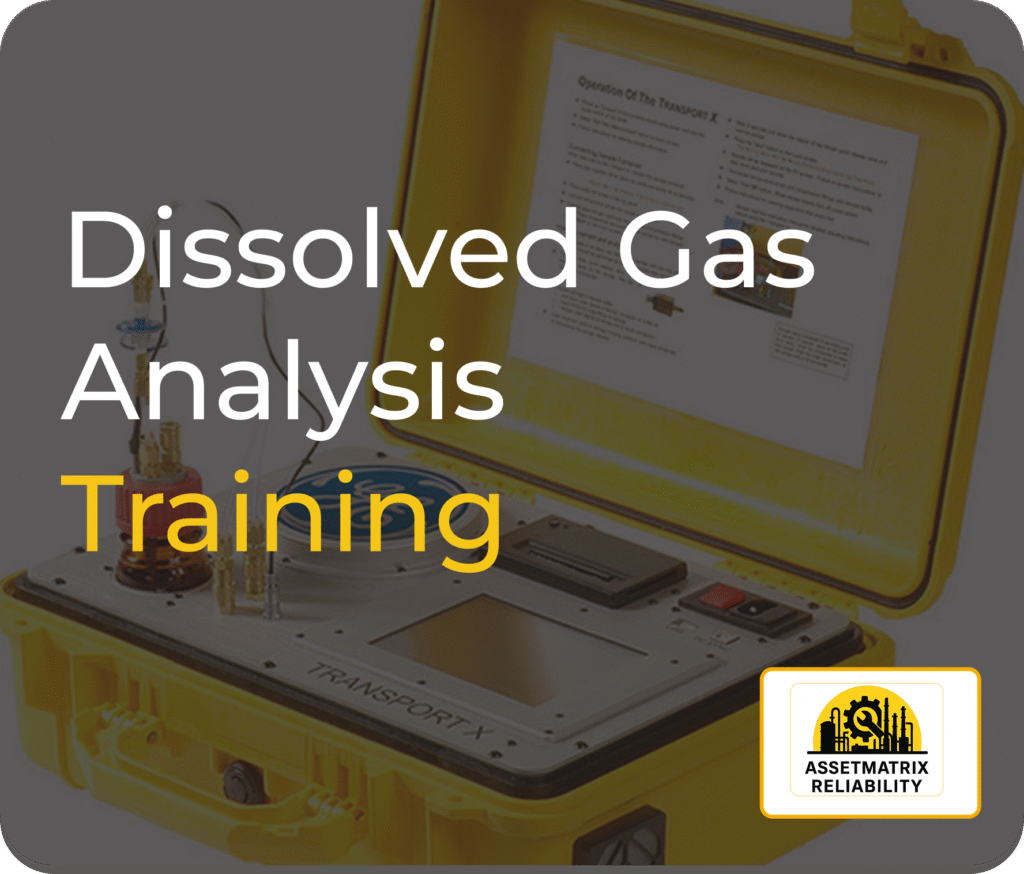
Dissolved Gas Analysis Courses
Oil Analysis Courses
Duration: 2 Days
A professional course in Dissolved Gas Analysis (DGA) is a specialized technical program designed for electrical engineers, asset managers, and laboratory chemists. DGA is used to analyze the gases dissolved in insulating oil to detect internal faults before a catastrophic failure occurs.
Who is this for: Electrical engineers, Chemical Engineers, laboratory professionals, Maintenance technicians, Technical consultants, Plant Managers and supervisors.
What you will learn:
- Gas Generation Theory: How heat and electricity break down oil and paper insulation into specific gases.
- Sampling Integrity: The critical techniques for collecting oil without letting atmospheric air in, which would ruin the data.
- Fault Identification and problem solving: Duval triangle and matching gas patterns to specific problems like arcing, overheating, or partial discharge.
Rotor Dynamic Balancing Courses
Rotor Dynamic Balancing
Duration: 2 Days
Rotor Dynamic Balancing is a specialized engineering course (often a subset of Rotor Dynamics or Vibration Analysis) that teaches the theory and practical techniques for redistributing the mass of a rotating body so that its center of mass aligns with its axis of rotation.
Who is this for: Maintenance technicians, mechanical engineers, machinery operators, Plant managers and supervisors and reliability engineers.
What you will learn:
The course typically focuses on identifying and correcting three types of unbalance:
- Static Unbalance: Where the center of mass is offset but parallel to the axis (like a heavy spot on a thin disk).
- Couple Unbalance: Where two equal heavy spots are on opposite sides and opposite ends, causing the shaft to want to “rock.”
- Dynamic Unbalance: A combination of both, where the principal inertia axis is neither parallel to nor intersects the rotation axis.
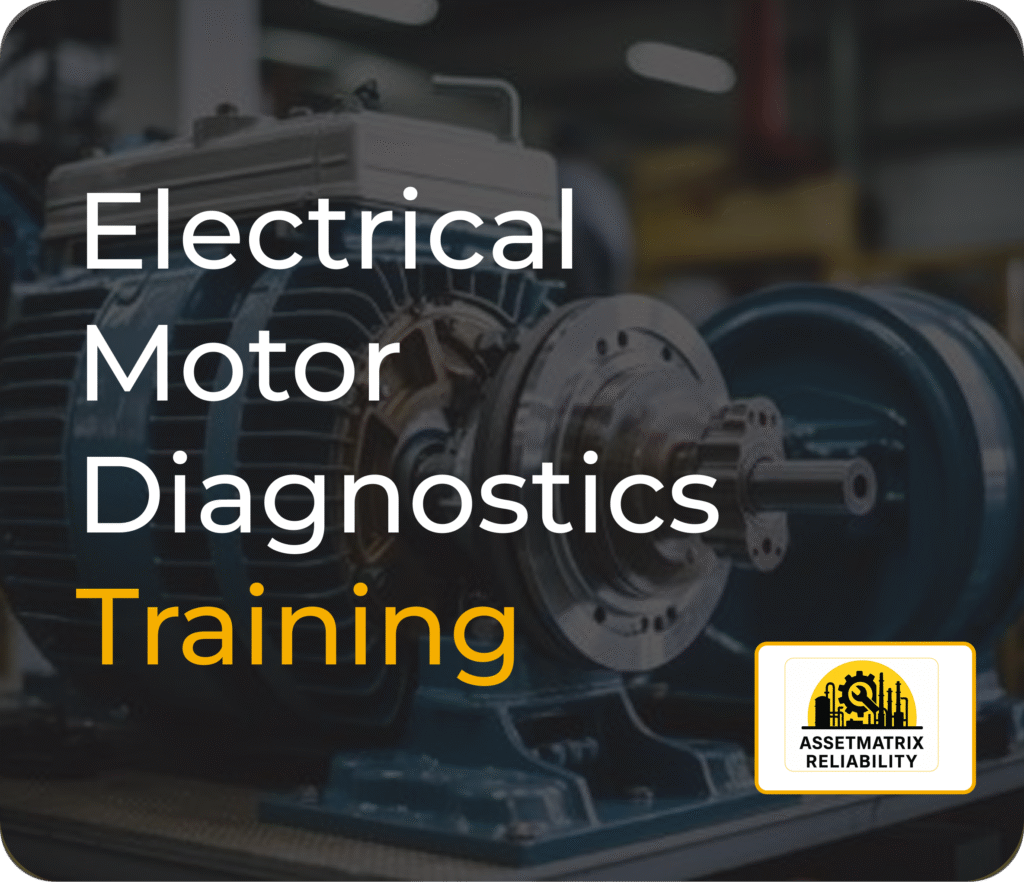
Electrical Motor Diagnostics Courses
5 Days (3 days for ESA, 2 days for MCA) these options are available for all candidates.
A professional course in Electrical Motor Diagnostics (EMD) is an advanced technical program that teaches you how to evaluate the internal health of a motor system by analyzing its electrical “signals” (current and voltage).
Who is this for: Electrical engineers, maintenance and reliability engineers, plant operators, mechanical engineers and CM specialists.
What you will learn:
- Identify electrical faults like insulation breakdown or “soft shorts.”
- Detect mechanical issues (like bearing wear) using electrical signals.
- Analyze the “quality” of the power entering the motor to prevent overheating.
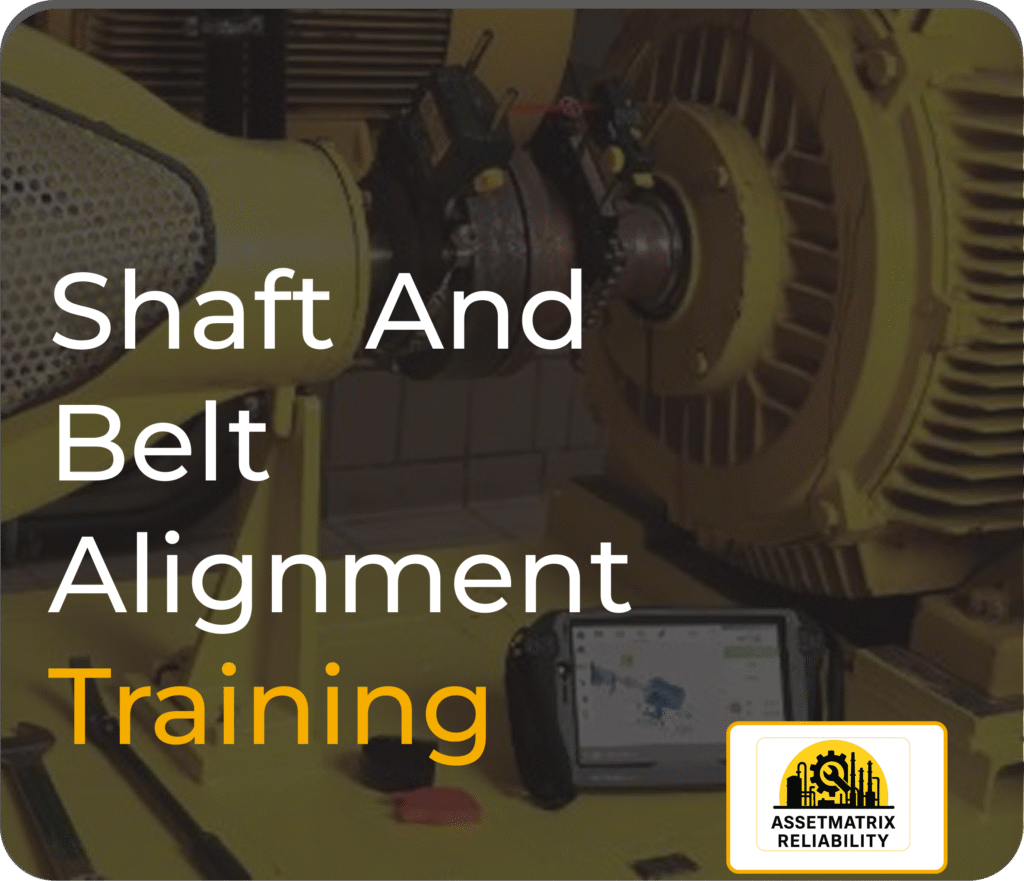
Shaft And Belt Alignment Courses
Duration: 2 Days
Shaft & Belt Alignment is a practical engineering course focused on the precise positioning of two or more rotating pieces of equipment (such as a motor and a pump) so that their axes of rotation are col-linear.
Who is this for: Mechanical engineers, maintenance officers, reliability personnel, (FMCG, Oil & Gas, Power plant) professionals
What you will learn:
This part of the course focuses on connecting two shafts via a coupling. Students learn to correct two types of misalignment:
- Offset (Parallel): The shafts are parallel but their center lines are not aligned.
- Angular: The shafts are at an angle to each other, creating a gap on one side of the coupling.
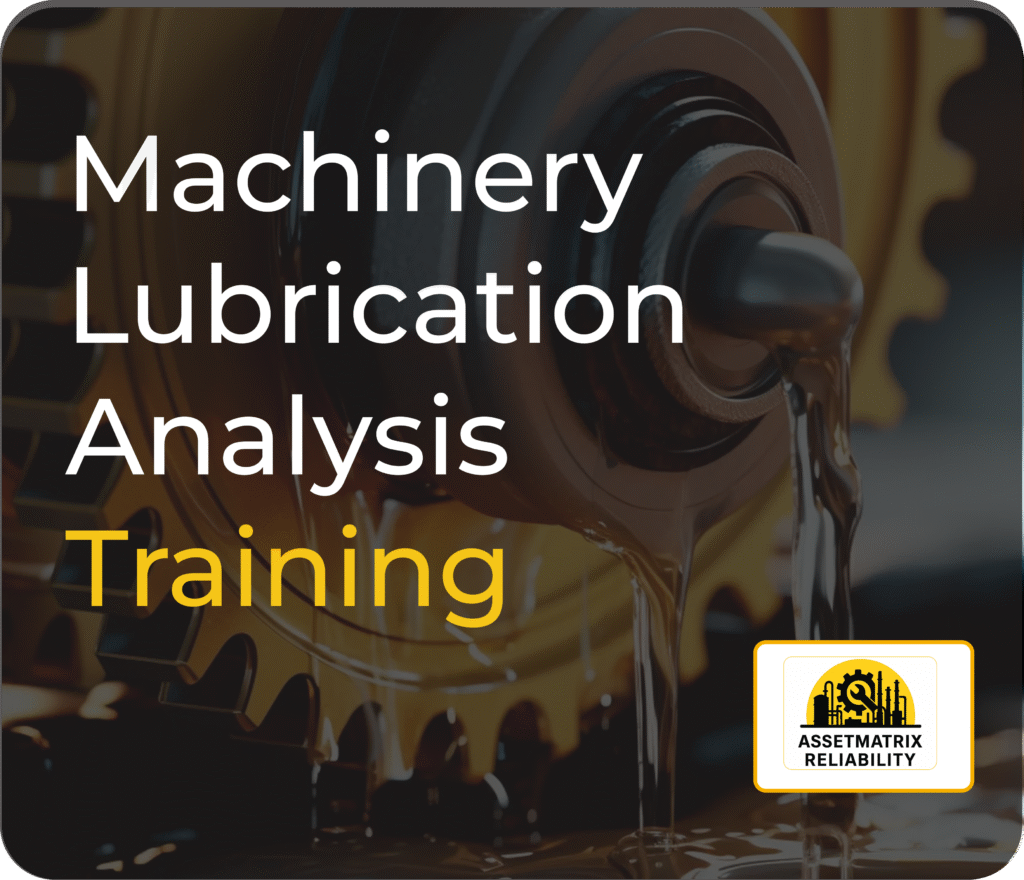
Machinery Lubrication Analysis Courses
Duration: 2 Days
A professional course in Machinery Lubrication Analysis (MLA)—aligned with ISO 18436-4 standards is an advanced reliability program that moves beyond “oiling machines” to mastering the science of Tribology.
Who is this for: Reliability specialists, mechanical engineers, plant managers and technical supervisors.
What you will learn:
- Master Precision Lubrication: Understand the “Four Rights”—The right lubricant, in the right place, at the right time, and in the right amount.
- Control Contamination: Identify and eliminate the #1 cause of machine failure—particles and moisture—by establishing strict “Target Cleanliness Levels.”
- Diagnose Machine Wear: Learn to differentiate between normal “break-in” wear and “catastrophic” wear (like fatigue or abrasive cutting) using wear debris analysis.
- Optimize Oil Life: Use lab data to extend oil drain intervals safely, drastically reducing lubricant costs and environmental waste.
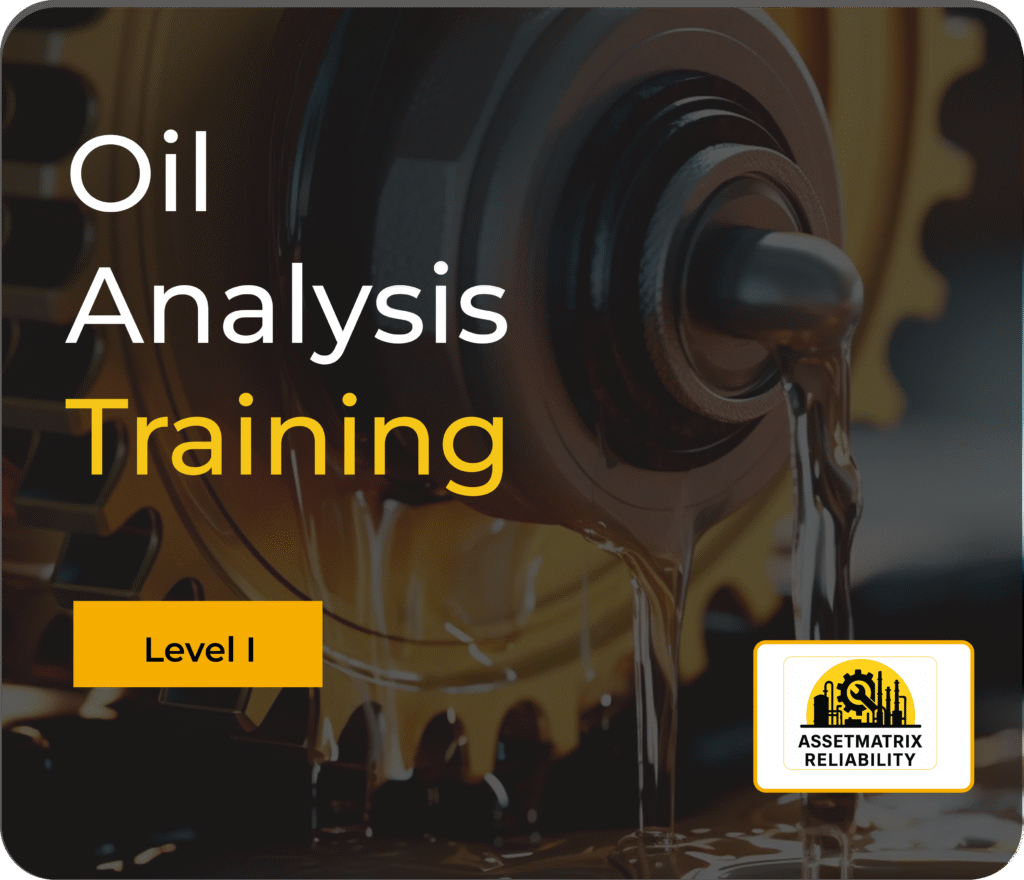
Oil Analysis Courses
Duration: 2 Days
Effective oil analysis is a powerful tool for predictive maintenance, helping organizations extend equipment life, reduce downtime, and optimize overall performance. Oil Analysis serves as the essential starting point for professionals looking to develop a deep understanding of oil analysis fundamentals.
Who is this for: Maintenance personnel, mechanics, and technical supervisors in the oil and gas sector, mining industry manufacturing and construction industries.
What you will learn:
By the end of a professional Oil Analysis course, you will be able to:
- Establish a “Sample-to-Action” Lifecycle: Design a precise sampling route where oil is collected from the correct “live” ports to ensure data accuracy.
- Interpret Laboratory Reports: Move beyond reading “Red/Yellow/Green” status lights and actually understand Spectroscopy, Analytical Ferrography, and Particle Counting (ISO 4406).
- Set Target Cleanliness Levels: Determine exactly how clean the oil must be for a specific asset based on its criticality to the factory.
- Calculate ROI: Quantify the savings gained by extending oil drain intervals and preventing $100,000+ catastrophic failures.
ABOUT US
BUILDING THE FUTURE OF RELIABILITY ENGINEERING IN AFRICA
Asset Matrix Reliability Centre (AMRC) is an accredited training and certification Centre dedicated to advancing the field of Electrical and Mechanical Asset Reliability and Condition Monitoring—spanning products, services, and solutions.
As an authorized partner of Mobius Institute, we deliver internationally recognized certification programs and practical reliability solutions that empower individuals and industries to achieve operational excellence.
We are more than just a training provider—we are a knowledge hub committed to equipping engineers, technicians, and organizations with the skills, tools, and strategies needed to improve asset performance, reduce downtime, and optimize maintenance operations.
At Asset Matrix Reliability Centre (AMRC), credibility and quality assurance are at the heart of everything we do. Our accreditations reflect our commitment to maintaining the highest global standards in training and consulting:
ISO 18436-2 Accredited Training
Certified to deliver ISO 18436-2 training in machine condition monitoring and diagnostics, we ensure courses meet global standards and equip participants with qualifications respected worldwide
ISO 18436-8 Accredited Training
Training programs comply with ISO 18436-8, the global standard for competence in condition monitoring and diagnostics. This accreditation reflects our commitment to world-class training and certification.
ANSI-Compliant Programs
Our training programs adhere to ANSI standards, ensuring that every certification we offer is internationally recognized and meets rigorous quality benchmarks.
Approved Mobius Institute Training Partner (MITP)
As an authorized Mobius Institute partner, we provide excellent courses with advanced materials, interactive simulations, and globally trusted methodologies.
Do You Have a Question For Us?
Go through our FAQs and you will find help
What is AMRC and what makes your training unique?
Our uniqueness lies in combining global certifications (ISO, ANSI, Mobius) with practical, hands-on training that addresses Africa’s real industrial challenges.
How do I register for a course?
Do you offer online or hybrid training options?
* In-person classes (at our Lagos centre or designated venues in Africa).
* Virtual/Online learning (live interactive sessions).
* Hybrid training (a mix of online theory + in-person practicals).
Do I need prior experience before enrolling?
* VCAT I, IRTCAT I, Ultrasound Level I → for beginners and entry-level technicians.
* VCAT II & III, Ultrasound Level II → for engineers and professionals with some experience.
* VCAT IV → for advanced specialists and consultants.
You can start at the level that matches your background, and our team can guide you if you’re unsure.